
Online Sim Racing Coaching in South Africa: What It Actually Fixes
Here is a thing that happens to almost everyone. You buy the direct drive base. You buy the load cell pedals. The rig is rigid, the FOV is correct, the…

Of all the upgrades in sim racing, this is the one people delay the longest and regret most.
Pedals are not exciting. They sit under the rig where nobody can see them. No YouTuber has ever opened a video shouting about a pedal set. And yet ask any professional driver or coach what matters most in a simulator and the answer is immediate and boringly unanimous: the brake pedal.
Your bundle pedals almost certainly use a potentiometer. It measures how far the pedal travels.
Your leg does not work that way. In a real car, you brake by pressure. Your muscle memory is calibrated to force, and force is what tells you how close the front tires are to locking.
A load cell measures pressure. That is the entire difference, and it changes everything downstream.
Your braking becomes repeatable. 60kg of pressure feels like 60kg every lap, every session, every month. You stop hunting for the brake point and start hitting it.
Trail braking becomes possible. Easing off pressure through corner entry while the front tires load up is a pressure task, not a travel task. On potentiometer pedals it is guesswork with a good day occasionally.
Your lap times tighten before they drop. This is the bit people misread. The first thing load cells fix is not your best lap; it is the gap between your best and average laps. Consistency is what wins races, and inconsistency is almost always a braking problem.
Here is the uncomfortable maths. Brake five meters too early into every corner of a 15-corner circuit and you are handing over multiple seconds a lap. No wheelbase in existence gets that back for you.
For most sim racers, yes. A cheap potentiometer brake limits lap-time consistency more than wheel torque or your display setup.
Which means if your budget is R10,000 and you are choosing between a better wheelbase and better pedals, the pedals win. A Sim Jack 200kg load cell set is R8,000. It will do more for your driving than R8,000 spent anywhere else on the rig.
Both measure pressure. The difference is in the feel.
Load cell (R8,000 to R11,400). A load cell with an elastomer stack. Firm, consistent, adjustable. For the overwhelming majority of drivers, this is the correct purchase and the end of the conversation.
Hydraulic (R12,100 to R12,500). A fluid system that gives a firmer, more progressive pressure curve, closer to a real car under heavy braking. The last few percent of realism, and genuinely noticeable if you also drive real cars.
If you are coming off bundle pedals, either one is a large jump. Load cell is the sensible buy. Hydraulic is the one you grow into.
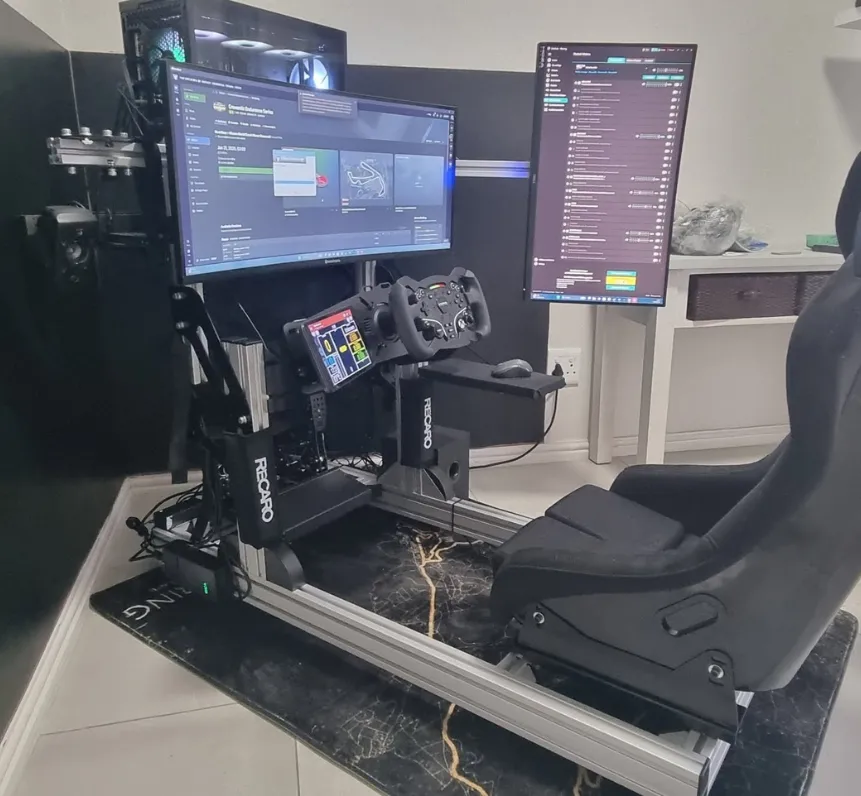
Bolting excellent pedals to a deck that flexes.
Load cells measure pressure. If the pedal deck moves under 80 to 100kg of braking force, the deck becomes an unintended second spring in the system, and the sensor’s accuracy drops. You just paid R12,000 for precision and then let the frame blur it.
Two things prevent this:
Push hard on the brake as if you are racing and watch the deck. If it moves, fix that before you buy anything else.
If your brake suddenly reads only about 20%, or the pressure curve becomes non-linear, that indicates a cracked load cell. Not a calibration issue, not a software issue. Stop adjusting settings and get it looked at.
If you race to be fast, it is the first thing you should buy.
If you race for fun, it is still the upgrade that makes the car feel like a car.
The only people who should skip it are those who have not yet fixed a flexing frame, because they would be paying for accuracy their rig cannot deliver.